

Configuration
Settings: Add-ons → Manage add-ons → Vendor Payouts Automation → Settings. Payout schedules per vendor plan and per vendor: Vendors → Vendor payouts → Schedules. All amounts are in the primary currency of the store.
General
Section titled “General”| Setting | Default | Description |
|---|---|---|
| Create payout requests automatically | Off | Main switch of the payout run. Off after installation so you can review balances and payout details first. While off, requests are only created with Create requests now or by vendors themselves. |
| Payout frequency | Monthly | Weekly, every two weeks, monthly, or manual only (no automatic requests). |
| Payout day (weekly and every two weeks) | Monday | The weekday a weekly or two-weekly payout is due. |
| Payout day of the month (monthly) | 1 | 1-28, so every month has it. |
| Minimum payout amount | 50 | A request is only created when the available amount reaches it. Smaller amounts stay in the balance. |
| Hold period (days) | 14 | Money of an order becomes available this many days after the order reached one of the statuses below. 0 = no hold period. |
| The hold period starts when the order reaches | Complete | One or more order statuses. Orders in a status that counts for vendor payouts but not in one of these (for example Processed) stay on hold. |
| Only create requests for vendors with payout details | On | Vendors without payout details are skipped (shown as “No payout details” on the balances page). |
| Flag requests when payout details changed in the last (days) | 7 | A changed bank account shortly before a payout is a common fraud pattern. Such requests carry a “Details changed recently” flag in the queue and in the administrator summary e-mail. 0 = never flag. |
| Show the Payouts page in the vendor panel | On | Off hides the vendor page and menu item; vendors then see only core Accounting. |
| Payout run | Shows the cron command, the cron URL and the time of the last run. |
How the available amount is calculated
Section titled “How the available amount is calculated”- Balance is the core vendor balance (the one on the Accounting page): orders in statuses that count for vendor payouts, minus commission, refunds, payouts and withdrawals. Pending withdrawals are already deducted.
- On hold is the part of the balance that belongs to orders still inside the hold period (net of their commission and refunds).
- Available for payout = balance − on hold. A request is created for this amount, rounded down to what the currency can pay.
Payout methods
Section titled “Payout methods”| Setting | Default | Description |
|---|---|---|
| Payout methods vendors can choose | Bank transfer, PayPal | Bank transfer (account holder, IBAN or account number, BIC/SWIFT, bank name), PayPal (e-mail), Other (free text: the vendor describes how to be paid). |
| Account holder (your company) | SEPA file only: your company name as the payer. | |
| Your IBAN | SEPA file only: the account the payouts are sent from. | |
| Your BIC (optional) | SEPA file only. Without it the file says “NOTPROVIDED”, which SEPA banks accept. |
The SEPA credit transfer file is offered only when the primary currency is EUR. Bank requests without an IBAN (account number only) are listed in the CSV file instead.
Notifications
Section titled “Notifications”| Setting | Default | E-mail template (Design → E-mail templates) |
|---|---|---|
| E-mail vendors when a payout request is created | On | Vendor payouts: payout scheduled |
| E-mail vendors when a payout is marked paid | On | Vendor payouts: payout sent (with your payment reference) |
| E-mail vendors when a payout request is rejected | On | Vendor payouts: request rejected (with your reason) |
| E-mail the administrator a summary after each payout run | On | Vendor payouts: requests await approval |
Vendor e-mails go to the vendor’s support e-mail address, like core accounting e-mails. When the add-on marks a request paid or rejected, the core “withdrawal approved/declined” e-mails are not sent, so vendors get one message.
Schedules per vendor plan and per vendor
Section titled “Schedules per vendor plan and per vendor”Vendors → Vendor payouts → Schedules lists every vendor plan (when the Vendor plans add-on is active) and every vendor with an own schedule. For each you can set frequency, payout day, day of month, minimum amount and hold period. Empty fields (“Default”) use the next level: a vendor setting wins over its plan, the plan over the add-on settings. Choose a vendor in the last row to add one; Use the default removes a vendor’s own schedule.
Payout run and cron
Section titled “Payout run and cron”The payout run checks every active vendor: is the payout day of the current period reached, does the period have no request yet, is no request waiting, does the vendor have payout details, does the available amount reach the minimum? Then it creates the request (on or after the payout day, once per period). Run it once a day:
php /path/to/store/admin.php --dispatch=kv_vendor_payouts.cronor call https://yourstore.com/admin.php?dispatch=kv_vendor_payouts.cron&cron_password=<cron password> (the cron password from Settings → Security; the URL is refused when that password is empty). Without cron, the run also starts at most every 15 minutes while administrators or vendors open pages in their panel (never on the storefront).
Privileges
Section titled “Privileges”| Privilege | Section | Gives |
|---|---|---|
| Vendor payouts: Can view | Vendors | The queue, batches, balances and schedules pages, statements |
| Vendor payouts: Can manage | Vendors | Approve, reject, mark paid, create requests, download files, edit schedules and payout details |
Administrators without user groups have both. Vendor administrators without user groups can open their Payouts page and save their payout details; vendor staff in a restricted user group need Can manage to change payout details.
License
Section titled “License”The license status is shown in a License card at the top of the add-on page, above the tabs, so you see it on every tab. The License tab holds the key itself. The key is stored once for the whole installation.
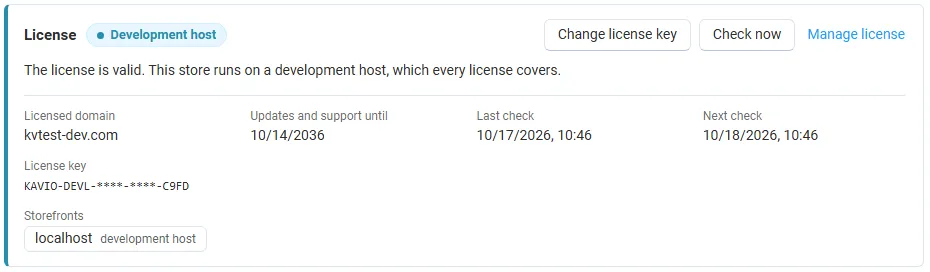
The License card shows:
- the status in color: green when valid, blue for a development host or the 14-day period before a key is required (with the days left), amber when the license server could not be reached (with the days left) or a Marketplace number is still being verified, red when the add-on is switched off;
- in plain words what the status means and, when the add-on is (or will be) switched off, what stops: no new payout requests are generated, and batch files, statements and the vendor Payouts page are switched off; core balances and withdrawals keep working, and requests already created can still be approved, rejected or marked paid;
- the licensed domain, every storefront with its result (covered, development host, not covered), the end of the updates and support period, the last and the next check, and the key in use (masked);
- the actions Enter license key / Change license key (opens the License tab), Check now (verifies at once and stays on the page), Manage license (your licenses on cs-cart.kaviolabs.com) and, without a valid license, Buy a license.
In Add-ons → Manage add-ons the add-on’s row shows a small license badge next to its name, for example License: Valid or License: Pending · 9 days left.
The add-on’s own admin pages show the license status in a bar at the top: a small green chip when the license is valid, or a banner with the status, what is switched off and the same actions as the card. Vendors never see license information.
| Setting | Description |
|---|---|
| License key | Your Kavio Labs license key (KAVIO-XXXX-XXXX-XXXX-XXXX, from My licenses on cs-cart.kaviolabs.com) or your CS-Cart Marketplace license number. If you entered the Marketplace license number in Add-ons → Manage add-ons (the add-on’s license field), leave this empty: the add-on uses that number. |
| License status | Points to the License card and explains what the check sends. |
What the license covers. A license is bound to the base domain you entered at purchase (for example example.com) and covers every subdomain of it (www.example.com, shop.example.com, staging.example.com). Local development hosts are always allowed: localhost, 127.0.0.1 and other private IP addresses, and host names ending in .localhost, .test, .local, .example or .invalid. A marketplace on a different base domain needs its own license. If you move your marketplace to a new domain, contact support.
When the add-on checks. When you save the key, and then once a day. The check runs only in the admin panel (on a page you open) or from cron, never while customers browse the storefront or place orders, and takes a few seconds at most. A cron job keeps the license verified even when nobody opens the admin panel:
php /path/to/store/admin.php --dispatch=kv_vendor_payouts_automation_license.checkWhat is sent. The check sends this to https://cs-cart.kaviolabs.com and nothing else: the license key, the add-on ID and version, the host names of your storefronts, your CS-Cart version and edition, and a random one-time value. No customer, vendor, order, payout or bank data is sent. The server answers with a digitally signed result, so a forged answer is ignored.
Statuses.
| Status (card) | Color | What happens |
|---|---|---|
| Valid | Green | The license is valid for this domain. Everything works. |
| Development host | Blue | The store runs on a local development host, which every license covers. Everything works. |
| Pending verification | Amber | A CS-Cart Marketplace license number was accepted, but the Marketplace has not confirmed it yet. Everything works. |
| Pending · N days left | Blue | No verified key yet (a new installation). Everything works for 14 days. |
| Grace period · N days left | Amber | The last checks failed (for example a network problem). The add-on keeps working for 14 days after the first failed check. |
| Not activated, Invalid key, Revoked, Domain mismatch, Not verified | Red | No new payout requests are created (cron, panel and Create requests now), batch files and statements cannot be downloaded, and the vendor Payouts page shows a notice. The payout queue keeps working: requests already created can be approved, rejected and marked paid, and core balances, withdrawals and the Accounting page are not affected. Domain mismatch shows the licensed domain next to the domain your store runs on. |
When your updates and support period ends, the add-on keeps working. Only updates and support stop.
License information appears in the admin panel only, and only for administrators who may manage add-ons; vendors and customers never see it. When the add-on is switched off, other admin pages also show a notice once per session with a link to the add-on page; the add-on page and the add-on’s own pages show the card or the status bar instead.